
On 28th April, World Day for Safety and Health at Work (World HSE Day), we reflect on a fundamental principle of industrial safety: the most effective way to prevent an accident is to remove or reduce exposure to risk.
For HSE Managers in the plastic packaging, extrusion, and conversion industries, the "danger zone" is often the slitting section. In these high-speed environments, industrial razor blades and pelletizer knives are essential but hazardous tools. Every time a machine stops for a blade change, the probability of an injury increases.
At Fortisblades, we believe that safety and productivity are not competing interests. By focusing on blade longevity and packaging, we help companies reduce their risk profile while maintaining peak operational efficiency.
How to Lower HSE Risks in Extrusion by Reducing Blade Change Frequency
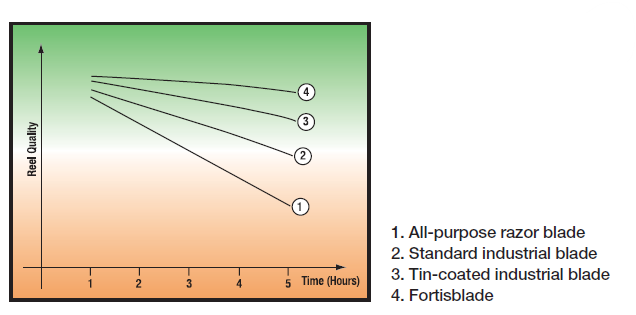
Fewer Blade Changes, Fewer Injuries
The logic is straightforward: the fewer times an operator must physically handle a blade, the fewer opportunities there are for an incident. This is where the choice of blade becomes a genuine HSE lever, not only a production quality decision.
In any risk management framework, reducing the probability of exposure is as important as mitigating severity. A blade that lasts significantly longer than a standard industrial razor directly reduces the frequency with which operators are exposed to the most critical moment in the blade-handling cycle: the change.
The Link Between Quality and Operator Safety
It is often overlooked that a blade’s cutting performance is directly linked to workplace safety. As detailed in our analysis of the impact of blade choice on slit quality, poor-quality blades produce dust and irregular edges.
Poor slit quality often forces operators to make manual "on-the-fly" adjustments to the machinery. Any time an operator is required to troubleshoot near a running web or a cutting head to correct a poor cut, the risk is near.
A sharp, high-quality blade ensures a clean cut for longer, keeping the machine running smoothly and keeping the operator's hands away from the equipment.
Industrial Razorblade Safety Box
Effective razor blade handling begins before the blade ever reaches the machine. The Fortisblades safety box incorporates physical guards designed to make sure the blade is picked up the right way.
Packaging Safety Guards
Implementing guards on the safety box as physical barrier to address safety hazards is a great way to ensure the correct handling of industrial razorblades. Our packaging design is rooted in safety principles, forcing users to handle the blade with an industry-accepted safe method. Our packaging also ensures that the sharp edge of the blade is protected from damage.
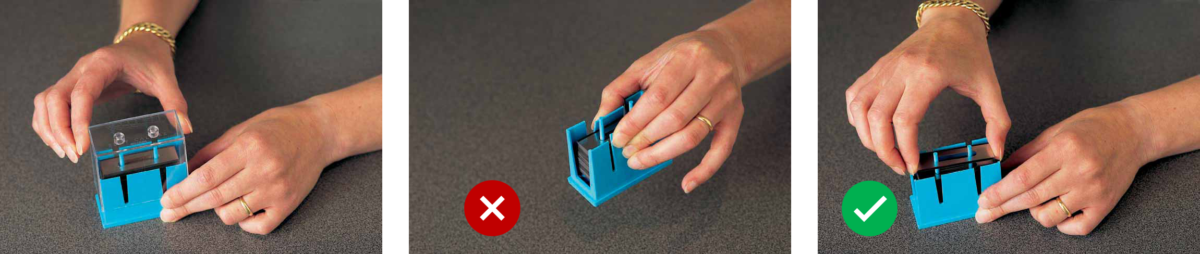
Although we recommend the usage of safety gloves when handling industrial razor blades, gloves make it harder to pick out only 1 blade. Thanks to the safety guards, the operator can only pick up the blade at the safe edge of the blade.
The Right Blade, Every Day: A Small Decision That Protects Your People
Safe work practices are most effective when they are embedded in the tools and materials operators use every day, not just in the procedures posted on a wall. When the packaging itself guides correct handling, and when the blade lasts long enough to minimise the frequency of hazardous interactions, safety becomes structural rather than behavioural.
Is Your Blade Specification Part of Your HSE Strategy?
This World HSE Day, we invite HSE managers, production directors and quality teams in the plastic packaging, extrusion and converting industries to review their blade specifications. Not only for their impact on slit quality and uptime, but for what they mean for the people on your production floor.